
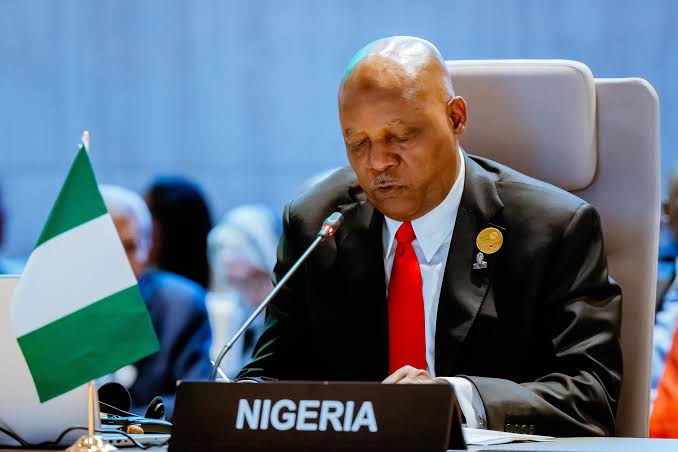
Nigeria is drawing a firmer line over the treatment of its citizens in South Africa, with Vice President Kashim Shettima warning that Abuja will no longer quietly accept what it describes as the recurring dehumanisation, humiliation and mistreatment of Nigerians.
Shettima’s warning came as he departed Luanda, Angola, on Monday after representing President Bola Ahmed Tinubu at the 21st Extraordinary Session of the African Union Assembly, where Nigeria formally escalated the issue of xenophobic and Afrophobic attacks in South Africa to the continental body.
The development marks a notable shift in tone. While Nigeria says it still prefers dialogue with Pretoria, Shettima made clear that diplomatic restraint should not be interpreted as acceptance.
“The government and people of Nigeria will no longer countenance a situation whereby our people are dehumanised and put into very, very unacceptable situations,” he said.
The Vice President added that Nigeria wanted “very robust conversations” with South Africa but would make its position “vehemently clear” whenever the safety and dignity of Nigerians were threatened.
‘Those whose palm kernels were cracked…’
Shettima invoked Nigeria’s historic role in the liberation of Southern Africa, arguing that the country’s contribution to the struggle against apartheid makes the treatment of Nigerians in contemporary South Africa particularly painful.
“Those whose palm kernels were cracked by benevolent spirits should learn to be humble,” he said, recalling Nigeria’s support for liberation movements and countries in Southern Africa.
His comments were contained in a statement issued by his Senior Special Assistant on Media and Communications, Stanley Nkwocha, whose X account @stanleynkwocha_ has also carried the State House statements on the matter. Recent posts from the account show that the administration is presenting the issue as both a diplomatic concern and a continental African solidarity question.
Tinubu takes the matter to the AU
The warning followed a direct diplomatic intervention by President Tinubu at the AU summit.
Speaking through Shettima, Tinubu urged African leaders to address recurring xenophobic and Afrophobic attacks against Africans and other foreign nationals in South Africa and asked that the matter be placed on the agenda of the AU’s 40th Ordinary Session in January 2027.
Nigeria argued that attacks on African nationals undermine continental solidarity, unity and peaceful coexistence, while acknowledging South Africa’s sovereign right to enforce its immigration laws.
The move effectively takes the dispute beyond bilateral Nigeria-South Africa relations and places it before Africa’s principal political organisation.
Nigeria chooses diplomacy — but says restraint has limits
Despite the tougher language, Shettima stopped short of threatening retaliation or confrontation.
He stressed that Nigeria’s preferred route remains dialogue and diplomatic engagement.
“We don’t want to overheat the polity,” he said, while insisting that there are moments when Nigeria must clearly state that certain actions are unacceptable.
The Vice President also called on South African authorities to ensure that immigration enforcement respects human dignity and protects lives.
That balancing act appears deliberate: Abuja is seeking stronger action without allowing the dispute to deteriorate into another major diplomatic confrontation between two of Africa’s most influential countries.
Why the issue resonates strongly in Nigeria
The controversy has particular emotional weight in Nigeria because South Africa remains a major destination for Nigerian businesses, professionals, students and migrants, while Nigerian public memory retains the country’s role in opposing apartheid and supporting liberation movements across Southern Africa.
The latest Nigerian intervention also comes amid a broader continental conversation about migration, irregular immigration and the treatment of African nationals across borders.
NTA reported that Ghana has also previously pushed for AU attention to attacks against African nationals in South Africa and proposed a fact-finding mission, although South Africa has argued that migration is a broader continental issue rather than a problem that should be framed around one country.
Social media reaction: anger, pride and a dose of self-reflection
The issue has also travelled quickly across Nigeria’s online political conversation.
Official and government-linked X accounts have amplified the message, with @stanleynkwocha_ publishing the State House position and referencing President Tinubu’s call for urgent continental action. The posts have subsequently been circulated by other Nigerian public figures and government-linked accounts.
The broader online debate, however, is more complicated than simple outrage.
One strand of Nigerian commentary welcomes the tougher diplomatic posture and argues that Nigerians abroad deserve the same protection and dignity that Nigeria expects for foreign nationals living in the country.
Another strand has questioned whether Nigeria can condemn xenophobia abroad while incidents of ethnic profiling, hostility towards migrants and exclusionary rhetoric also occur within Nigeria. That counterargument has appeared in Nigerian commentary in recent months, including criticism that Nigerians sometimes condemn overseas discrimination while overlooking similar tendencies at home.
That tension is important because the debate is no longer simply about Nigeria versus South Africa. It is increasingly about what an integrated Africa should look like — and whether African governments can protect citizens across borders while simultaneously enforcing immigration laws.
The bigger question: what happens in January?
Nigeria has succeeded in getting the issue onto the diplomatic radar of the African Union, but the harder test will come with the proposed discussion at the AU’s January 2027 Ordinary Session.
For Abuja, the immediate objectives are clearer: greater continental attention, protection of Nigerians in South Africa and stronger safeguards against xenophobia and Afrophobia.
For Pretoria, the challenge will be balancing domestic immigration enforcement and political pressure over migration with its obligations toward African nationals living and working in South Africa.
For Nigerians following the dispute, Shettima’s warning represents a message that has been demanded repeatedly whenever Nigerians abroad face violence or humiliation:
Nigeria says diplomatic patience remains intact — but it is no longer willing to confuse patience with silence.