

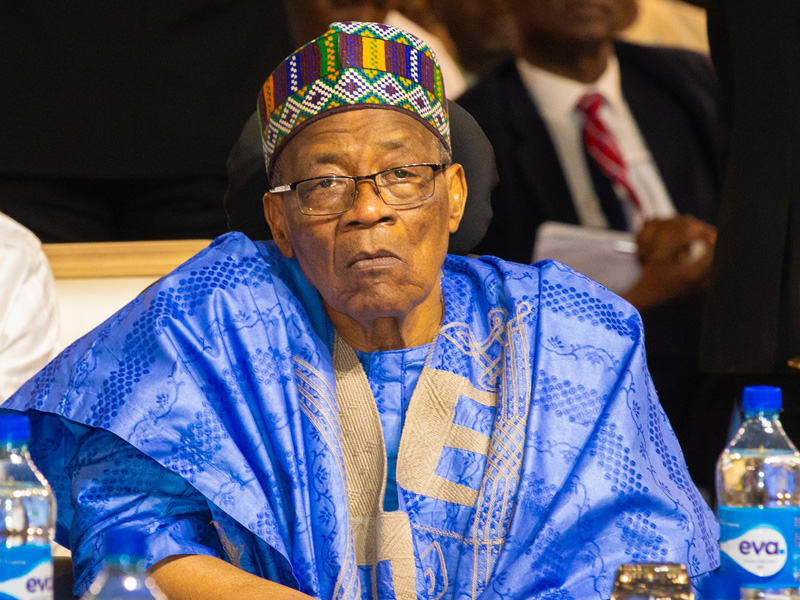
Former military President Ibrahim Badamasi Babangida has again described the annulment of the June 12, 1993 presidential election as a “collective decision,” but his latest account leaves unanswered a fundamental question: what precisely was his own personal involvement in the decision?
Babangida, who turns 85 on Sunday, August 16, made the remarks during an interview with Badeggi 90.1 FM in Minna, Niger State, as part of activities marking his birthday. Badeggi Radio is a Minna-based station.
His comments come against the background of renewed scrutiny of Nigeria’s military and political history, including investigations into an alleged plot to overthrow President Bola Ahmed Tinubu in 2025.
Babangida argued that successful military coups in Nigeria had historically depended on civilian support, saying wealthy civilians had at various times played important roles in financing or facilitating military takeovers.
But it was his comments on the June 12 election that are likely to attract the greatest attention.
According to Babangida, the decision to annul the election won by Chief Moshood Kashimawo Olawale Abiola was “one of the toughest decisions” of his military career.
He nevertheless maintained that the annulment was “a collective decision taken in what was considered the overall interest of the country at the time.”
That formulation, however, does not settle the question of responsibility.
As the military head of state, Babangida was not merely a member of a distant decision-making body. His administration formally annulled the election, and the June 26, 1993 broadcast announcing the cancellation was made on behalf of his government and the National Defence and Security Council. Contemporary historical accounts also place Babangida and his ruling council at the centre of the decision.
What remains unclear from Babangida’s latest explanation is where his personal position ended and the “collective decision” began.
Did he personally favour annulment? Did he oppose it before accepting the position of the council? Did he propose it, approve it, or merely endorse a decision already reached by others? And which members of the military leadership actually pushed for the cancellation?
Those questions matter because describing the decision as collective can distribute responsibility across an institution without fully accounting for the role of the individual who headed that institution.
Babangida’s explanation of the 1985 alleged coup plot involving his childhood friend, the late General Mamman Jiya Vatsa, offers a striking contrast.
He recalled that Vatsa and General Mohammed Gado Nasko were summoned to his office after allegations emerged that they were involved in a plot to overthrow his government. Both men, according to Babangida, denied the allegations. A subsequent military investigation cleared Nasko but implicated Vatsa.
Babangida said he was “shocked, devastated and deeply disappointed” when Vatsa was found culpable, adding that he could not save his friend from the consequences of military law. Vatsa was subsequently executed in March 1986.
Babangida’s account portrays him as a leader constrained by institutional decisions in the Vatsa affair, just as his June 12 explanation portrays the annulment as the product of collective responsibility.
Yet the historical significance of June 12 makes the question of individual responsibility particularly difficult to avoid.
The annulment destroyed the result of an election widely regarded as one of Nigeria’s freest and fairest and plunged the country into a prolonged political crisis. Babangida’s government eventually left power in August 1993, but the political consequences of the annulment continued to shape Nigeria’s history.
Babangida also spoke warmly about Abiola, describing the businessman and politician as a close personal friend whose philanthropy crossed ethnic, religious and regional boundaries.
His praise for Abiola adds another layer to the June 12 controversy: the man he now remembers as a generous friend was also the candidate whose electoral victory his government annulled.
The former military ruler also urged Nigerians to remain hopeful about the country’s economic and security challenges and to support President Bola Ahmed Tinubu’s administration, expressing optimism that its policies would eventually produce positive results.